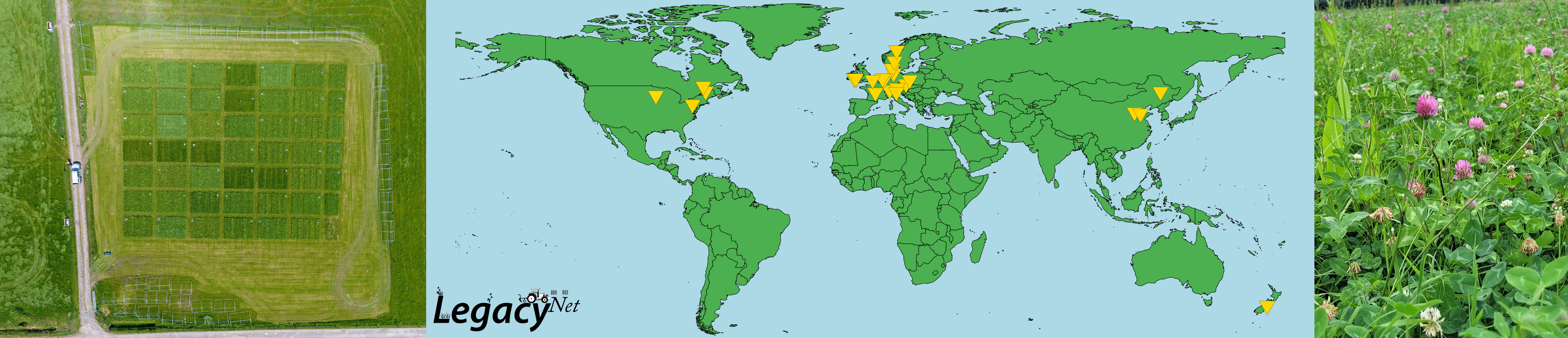
LegacyNet is a voluntary network of experimental sites that was set up to investigate the yield benefits of multispecies grassland leys, as well as their legacy effects on follow-on crops in a rotation. A common experiment was conducted across multiple sites. At each site, grassland plots were established that systematically varied in the species diversity of grasses, legumes and herbs, ranging from monocultures up to six species mixtures, and plots were monitored for a range of responses. Following the grassland ley phase, a follow-on crop was sown on each plot to investigate the effect of varying species diversity in a grassland ley on the performance of a follow-on crop.
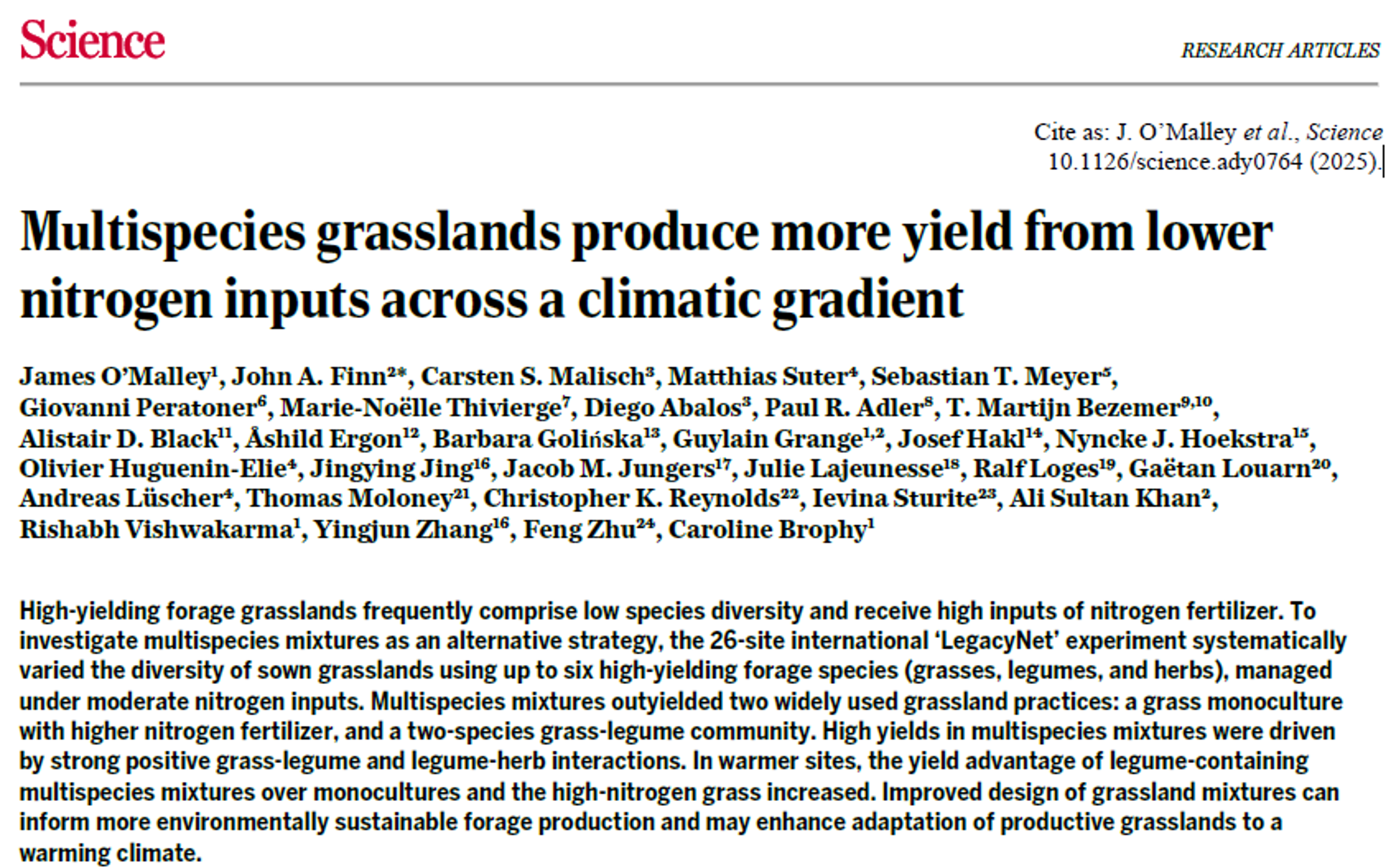
The first results from LegacyNet investigating the effects of species diversity on the yield in the grassland ley are now published in Science. We found that multispecies mixtures outperformed a high nitrogen grass monoculture, and a 70:30 combination of ryegrass and white clover at the same nitrogen level. We also found potential for multispecies mixtures to be a climate adaptation solution. You can read the results in full in our paper Multispecies grasslands produce more yield from lower nitrogen inputs across a climatic gradient.
We are continuing to investigate how to best design productive grassland, not just for yield but for other responses including forage quality and the resistance of weed invasion. We are also investigating carry-over effects of a grassland (supply of symbiotically fixed nitrogen, soil health and fertility) on the yield and nitrogen yield of a follow-on crop.
Can we identify specific grassland species combinations that are best at delivering functions across a crop rotation? Ultimately, LegacyNet investigates the use of multispecies grassland leys as a practical farm management strategy to improve:
- the quantity and quality of forage yield,
- the resource use efficiency and ecosystem services from grassland leys and
- the legacy effects of such grassland leys within crop rotation systems.